Treatment
Targeted cancer drugs work by targeting the differences in cancer cells that help them to grow and survive.
Immunotherapy uses our to fight cancer. It works by helping the immune system recognise and attack cancer cells.
Some drugs work in more than one way. So they are targeted as well as working with the immune system.
Find out more about targeted and immunotherapy drugs
These drugs are used in different situations to treat breast cancer. The most common way to have it is before and after breast cancer surgery.
Treatment before surgery is called neo adjuvant therapy. You may have it to try to shrink a large cancer. This might mean that you can have a smaller operation. For example, you might be able to have just the tumour removed (a lumpectomy) instead of a
This is called adjuvant treatment. The aim of this treatment is to lower the risk of the cancer coming back.
You may also have targeted and immunotherapy drugs instead of surgery, if surgery is not an option for you.
Breast cancer can spread to other parts of the body such as the lungs and bones. This is secondary breast cancer. Targeted and immunotherapy drugs are possible treatments for secondary breast cancer. They can:
relieve symptoms
reduce the size of the cancer
improve your
There is a lot of research looking at targeted drugs for breast cancer. You may hear about new drugs as they become available. Do ask your doctor or nurse if you have any questions, they will explain if any new treatment is suitable for you.
Find out more about research for breast cancer
Not all targeted and immunotherapy drugs are suitable for you. Some are only available if the breast cancer cells have certain receptors. Your doctor does various tests on the cancer cells to find this out.
For example, some breast cancers have a change which means that they produce large amounts of a protein called human epidermal growth factor receptor 2 (HER2). These are called HER2 positive breast cancers. So in this situation, you might have treatment that targets these HER2 receptors. An example of treatment that targets this receptor is such as trastuzumab.
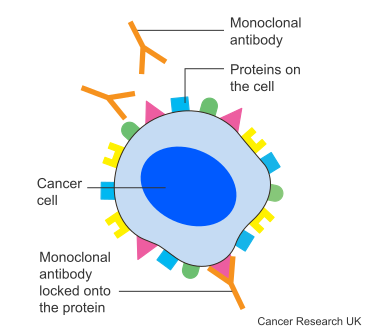
You might have this type of treatment on its own, with other targeted or immunotherapy drugs, or with other treatments such as chemotherapy or hormone therapy.
Your doctor may also check for a protein called PD-L1 on the surface of cancer cells if you have secondary triple negative breast cancer. To test your cancer cells, doctors need a sample of your cancer. They may be able to use a sample from a biopsy or operation you have already had.
Find out more about tests doctors might do on your breast cancer cells
There are many different types of targeted and immunotherapy drugs. We describe some of the drugs used for breast cancer below.
Your doctor can tell you whether any of these treatments are suitable for you.
You have your treatment as tablets or capsules or as a dip into your bloodstream. This depends on the type of drug you have.
Whether you have a full or empty stomach can affect how much of a drug gets into your bloodstream.
You should take the right dose, not more or less.
Talk to your healthcare team before you stop taking a cancer drug, or if you have missed a dose.
You have treatment through a thin short tube (a cannula) that goes into a vein in your arm each time you have treatment.
Or you might have treatment through a long line: a central line, a PICC line or a portacath. These are long plastic tubes that give the drug into a large vein in your chest. The tube stays in place throughout the course of treatment. This means your doctor or nurse won't have to put in a cannula every time you have treatment.
All treatments have side effects. These vary depending on the type of treatment you have. Side effects also vary from person to person. The side effects you have depend on:
whether you have it alone or with other treatments
the amount of drug you have (the dose)
how long you have had treatment for
your general health
Targeted therapy drugs and immunotherapy drugs can cause serious side effects. Your doctor or nurse will talk to you about this. Always tell them about any side effects you have and follow the advice they give you. Some of the common side effects include:
tiredness (fatigue)
loss of appetite
low levels of blood cells
feeling or being sick
skin changes such as red and sore skin or an itchy rash
flu-like symptoms such as chills, fever, dizziness
diarrhoea
A side effect may get better or worse during your course of treatment. Or more side effects may develop as the treatment goes on. For more information about the side effects of your treatment, go to the individual drug pages.
It can be difficult to cope with the side effects of targeted and immunotherapy treatment. There are things you can do to help you cope with the side effects of cancer treatment.
Find out more about the side effects of cancer drugs
Researchers are looking at new and different types of targeted and immunotherapy drugs for breast cancer.
They are also looking into different combinations. This includes combining them with chemotherapy or other types of drugs. They want to find out if they improve how well they work.
Find clinical trials with targeted and immunotherapy drugs for breast cancer
Treatment with immunotherapy or targeted cancer drugs can be difficult to cope with for some people. Your nurse will give you a number to call (advice line) if you have any problems at home.
Get practical, physical and emotional support that can help you cope with breast cancer
Last reviewed: 17 Jul 2023
Next review due: 17 Jul 2026
There are many cancer drugs, cancer drug combinations and they have individual side effects.
Treatment for breast cancer depends on a number of factors. Find out about breast cancer treatments, where and how you have them, and how to cope with possible side effects.
Deciding about treatment can be difficult when you have secondary breast cancer. Treatments such as chemotherapy or radiotherapy can help to reduce symptoms and might make you feel better.
Get practical, physical and emotional support to help you cope with a diagnosis of breast cancer, and life during and after treatment.
Survival is generally very good for breast cancer, particularly if you are diagnosed early. This is probably because of screening, early diagnosis and improved treatment. Find out more.
Find out about breast cancer, including symptoms, diagnosis, treatment, survival, and how to cope with the effects on your life and relationships.

About Cancer generously supported by Dangoor Education since 2010. Learn more about Dangoor Education



Search our clinical trials database for all cancer trials and studies recruiting in the UK.

Connect with other people affected by cancer and share your experiences.

Questions about cancer? Call freephone 0808 800 40 40 from 9 to 5 - Monday to Friday. Alternatively, you can email us.
