Treatment for lung cancer
Cryotherapy is usually a treatment for metastatic (advanced) lung cancer. You might also have it if you’re not fit enough for surgery.
Cryotherapy can shrink a tumour that is blocking an airway. This can relieve breathlessness and other symptoms such as:
a cough
coughing up blood
a chest infection in the blocked part of the lung
Unfortunately it can’t cure your cancer.
You normally have cryotherapy as a day case procedure in the hospital's endoscopy unit or CT room.
Your doctor or specialist nurse explains what happens and how they do the treatment. They ask you to sign a consent form saying that you agree to have the procedure. You can ask them any questions that you have. Tell them about any medicines you are taking.
Take your medicines as normal unless your doctor tells you otherwise. You might need to stop any blood thinning medicines before your treatment but your doctor will let you know.
You will have a . So you shouldn’t eat or drink anything from midnight of the night before your cryotherapy. Only drink clear fluids until 6 am on the day of your procedure.
Some hospitals allow you to have just water for up to 2 hours before surgery and sips of water until surgery.
In the endoscopy department, a nurse will ask you to change into a gown. Then they show you into the treatment room.
Once you are lying on the couch, an anaesthetist gives you the anaesthetic medicine through a small tube put into a vein in your hand. This means you will be asleep and won’t feel anything during the cryotherapy.
Your doctor puts a long, thin, rigid or flexible tube called a bronchoscope down your throat and into the airway. They pass a probe down through the bronchoscope.
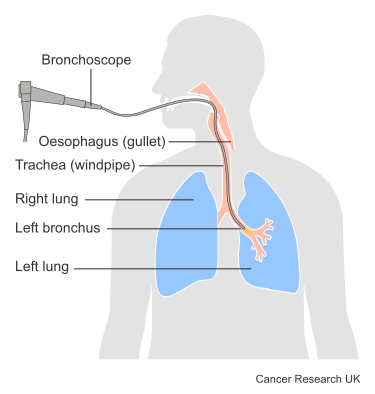
The tip of the probe freezes part of the tumour. The doctor then allows the area to thaw and they move the probe a little.
Your doctor repeats this process until they have treated the whole area of cancer. They remove as much of the tissue as possible using forceps or the probe.
It takes about 20 minutes.
Your doctor removes the bronchoscope.
After your cryotherapy, you can eat and drink once the anaesthetic has worn off. You might feel a bit confused and drowsy, but you won’t remember your treatment.
You should be able to breathe more easily than before the cryotherapy.
You can get changed into your own clothes once you feel less sleepy.
You will spend a couple of hours on the hospital ward. Your nurses will make sure you have fully recovered.
You should be able to go home the same day but take things easy for a day or so afterwards.
You shouldn’t drive until the day after the test because of the anaesthetic. Someone should collect you from the hospital and ensure you get home safely.
Some people stay overnight to help them completely recover from the procedure.
You might have a sore throat, hoarse voice or an irritating cough for a couple of days after the test because of the bronchoscopy tube.
You might cough up spit and pus that were trapped in a blocked and infected part of the lung.
Seeing some blood in your spit is normal after your cryotherapy treatment. It might give you a metallic taste in your mouth. If you are coughing up blood, let your doctor know straight away.
Your doctor will talk to you about the risks and benefits of having cryotherapy. It’s a safe procedure but every treatment has potential risks and side effects.
Cryotherapy should make it easier to breathe. Let your doctor know if you find it more difficult to breathe.
Let your doctor know if you develop any signs of a chest infection. This includes having a high temperature and your phlegm (sputum) changing colour.
The risk is small, but a hole can happen in the airway tissue (perforation) during cryotherapy. Or changes may happen to the airway tissue, such as an ulcer forming. If this happens, you might need a stent or surgery.
Your doctor will take extra care to prevent this from happening.
You can have the treatment again if the tumour starts to block the airway again. Or your doctor might suggest other treatments instead.
Last reviewed: 30 Oct 2025
Next review due: 30 Oct 2028
Your treatment depends on several factors. These include what type of lung cancer you have, how big it is and whether it has spread (the stage). It also depends on your general health.
Metastatic lung cancer is when the cancer has spread from the lung and gone to another part of the body.
There is support available during and after treatment to help you cope. This includes support from your clinical nurse specialist, cancer charities, community services, and family and friends.
Metastatic lung cancer can cause problems with your breathing. Some treatments can help you breathe more easily.
Feeling short of breath can be hard to live with. It can make you feel tired and like everything is a struggle. But some things can help you to cope.

About Cancer generously supported by Dangoor Education since 2010. Learn more about Dangoor Education



Search our clinical trials database for all cancer trials and studies recruiting in the UK.

Connect with other people affected by cancer and share your experiences.

Questions about cancer? Call freephone 0808 800 40 40 from 9 to 5 - Monday to Friday. Alternatively, you can email us.
