Treatment for lung cancer
You might have laser therapy if your cancer is blocking an airway and making you breathless. It can help you to breathe more easily again. You can have laser therapy along with other types of lung cancer treatment.
You have the treatment in hospital in the endoscopy department or x-ray department. It takes about 30 minutes.
Your doctor or specialist nurse explains what happens and how they do the treatment.
They ask you to sign a form saying that you agree to have the procedure. You can ask them any questions that you have. Tell them about any medicines you are taking.
You shouldn’t eat or drink anything except water for 4 to 6 hours before the treatment. You can drink water until 2 hours beforehand.
A nurse puts a small tube called a cannula into a vein in the back of your hand. They go with you to the endoscopy or x-ray department.
You have a medicine to make you sleepy (sedation) injected through the cannula. Or you might have a .
When you’re very sleepy or asleep your doctor gently puts a long flexible or rigid tube called a bronchoscope into your airways. The doctor passes a small laser down the bronchoscope tube.
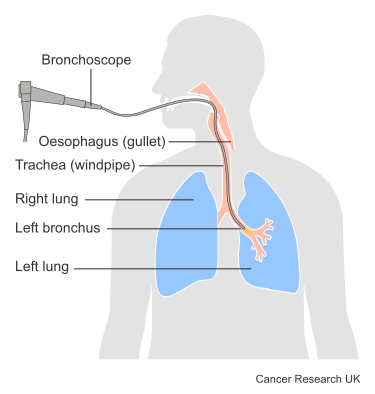
The doctor burns away as much of the tumour as possible with the laser. They then take out the bronchoscopy tube.
You stay in the endoscopy department or x-ray department until the sedation or anaesthetic wears off. You might feel a bit drowsy and confused for a while but you won’t remember any of the treatment. You might wear an oxygen mask for a short time. A nurse then takes you back to your ward.
You can usually go home that evening.
You might have a sore throat. Taking painkillers for a few days helps.
Tell your nurse or doctor if you still have pain.
You might have some slight bleeding and have some blood in your sputum (phlegm). It might give you a metallic taste in your mouth. This usually gets better over a few days.
Tell your doctor if you cough up blood.
Laser therapy is a safe treatment. There are usually very few side effects and they tend to be mild. But all treatments have potential risks.
Air or gas can leak into the space around the lung and make it collapse. This makes you feel very breathless. It can get better on its own or your doctor can put in a small tube to expand the lung again.
Let your doctor know straight away if your breathing gets worse after your treatment.
Let your doctor know if you develop any signs of a chest infection. This includes having a high temperature and your phlegm (sputum) changing colour.
The risk is small, but a hole can happen in the airway tissue (perforation) during laser therapy. Or changes may happen to the airway tissue, such as an ulcer forming.
Your doctor will take extra care to prevent this from happening.
You can have the treatment again if the tumour starts to block the airway again. Or your doctor might suggest other treatment.
Last reviewed: 16 Oct 2025
Next review due: 16 Oct 2028
Lung cancer starts in the windpipe (trachea), the main airway (bronchus) or the lung tissue. Cancer that starts in the lung is called primary lung cancer.
Your treatment depends on several factors. These include what type of lung cancer you have, how big it is and whether it has spread (the stage). It also depends on your general health.
Lung cancer starts in the windpipe (trachea), the main airway (bronchus) or the lung tissue. Cancer that starts in the lung is called primary lung cancer.
There is support available during and after treatment to help you cope. This includes support from your clinical nurse specialist, cancer charities, community services, and family and friends.
Feeling short of breath can be hard to live with. It can make you feel tired and like everything is a struggle. But some things can help you to cope.

About Cancer generously supported by Dangoor Education since 2010. Learn more about Dangoor Education



Search our clinical trials database for all cancer trials and studies recruiting in the UK.

Connect with other people affected by cancer and share your experiences.

Questions about cancer? Call freephone 0808 800 40 40 from 9 to 5 - Monday to Friday. Alternatively, you can email us.
