Stages types and grades
Doctors in the UK now use a tool called the Cambridge Prognostic Group (CPG). This divides prostate cancer into 5 groups. This helps them recommend if you need treatment and the type of treatment you need. The CPG uses information about:
the T stage from the TNM staging
Grade Groups or Gleason score
Prostate specific antigen (PSA) level
Read about the Cambridge Prognostic Group system (CPG)
It's important to know that the CPG system does not apply if you have cancer that has already spread to other parts of the body. This is metastatic or advanced prostate cancer.
Find out more about metastatic prostate cancer
Tumour describes the size or area of the cancer. This is a simplified description of the T stage.
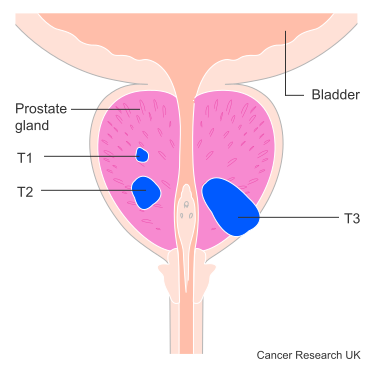
There are 4 main T stages of prostate cancer – T1 to T4.
T1 means the cancer is too small to be seen on a scan, or felt during an examination of the prostate. It’s divided into T1a, T1b and T1c.
T1a means that the cancer is in less than 5% of the removed tissue.
T1b means that the cancer is in 5% or more of the removed tissue.
Your surgeon might find a T1a or T1b cancer during surgery for other reasons.
T1c cancers are found by , for example after a raised PSA level.
T2 means the cancer is completely inside the prostate gland.
Doctors regularly update TNM staging systems. The latest version no longer divides T2 into sub stages if your doctor stages the cancer after surgery.
If you don't have surgery, your doctor might tell you you have T2a, T2b or T2c.
T2a means the cancer is only in half of one side ( ) of the prostate gland.
T2b means the cancer is in more than half of one lobe of the prostate gland. But it is not in both sides.
T2c means the cancer is in both lobes but is still inside the prostate gland.
Ask your doctor or specialist nurse what the sub stage means in your case if you are told about them.
T3 means the cancer has broken through the capsule (covering) of the prostate gland. It’s divided into T3a and T3b.
T3a means the cancer has broken through the capsule (covering) of the prostate gland.
T3b means the cancer has spread into the tubes that carry semen (seminal vesicles).
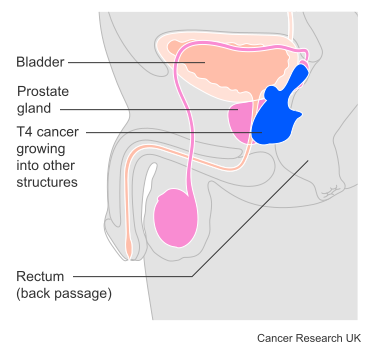
T4 means the cancer has spread into other body organs nearby, such as the back passage, bladder, or the pelvic wall.
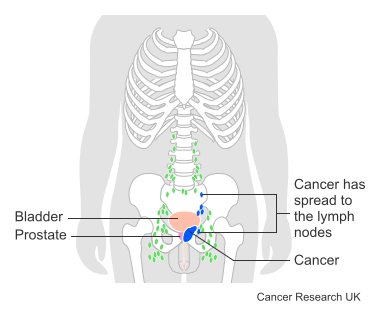
Node (N) describes whether the cancer has spread to the lymph nodes.
N is split into N0 and N1.
N0 means that the nearby lymph nodes don’t contain cancer cells
N1 means there are cancer cells in lymph nodes near the prostate
Metastasis (M) describes whether the cancer has spread to a different part of the body.
There are 2 M stages – M0 and M1.
M0 means the cancer hasn’t spread to other parts of your body.
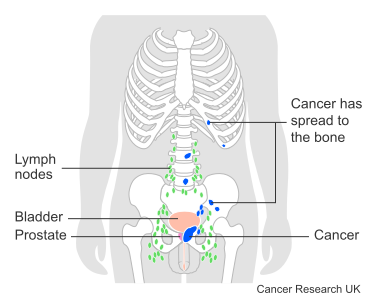
M1 means the cancer has spread to other parts of the body outside the . It is split into M1a, M1b and M1c.
M1a means there are cancer cells in lymph nodes outside the pelvis
M1b means there are cancer cells in the bone
M1c means there are cancer cells in other parts of the body such as the lungs
The TNM stage helps your doctor recommend if you need treatment and the type of treatment you need. Doctors also consider the following:
what the cancer cells look like under the microscope - this is the Grade Group
your PSA blood test level
If your cancer has not spread, your doctor puts you into one of the 5 Cambridge Prognostic Groups (CPGs). They do this by combining your Grade Group, PSA and T stage.
Doctors also consider other factors when recommending the best treatment for you:
How much cancer there is. They can base this on the number of samples that had cancer divided by the number of biopsies they took.
Your age and general health and any other medical conditions you have.
Whether you have an increased chance of having aggressive cancer. They base this on any changes you might have.
How you feel about what the treatments involve and the side effects.
You might not need treatment straight away. Some prostate cancers are slow growing and might never cause you problems or need treatment. Your doctor might suggest waiting and seeing whether the cancer develops. They monitor your cancer and starts treatment if the cancer begins to grow. Depending on your situation, they may call this active surveillance or watchful waiting.
If your cancer hasn't spread and you have treatment, you might have one of the following treatments:
surgery to remove your prostate - this is called a prostatectomy
with or without
internal radiotherapy - this is called
Some treatments are only available as part of a clinical trial. These include:
Your doctor can tell you if one of these treatments might be an option for you.
Read more about prostate cancer treatment
This is called metastatic prostate cancer. You can read more about the treatment options in the section about metastatic prostate cancer.
Read more about treatment for metastatic prostate cancer
The Predict Prostate tool can help you decide between monitoring and more radical treatment. It is for men who have:
prostate cancer that hasn't spread
a Cambridge Prognostic Group (CPG) of 1,2 or 3
The tool can't tell you exactly what is going to happen in the future. But it gives you an idea about the differences in survival between the different treatment options. The tool works less well for men with a very high PSA or those with a fast growing or large cancer.
To be able to use the tool you need to know the following about your cancer:
PSA level
T stage of your cancer
the Grade Group
how much cancer there is - this is based on the number of biopsy samples that contained cancer divided by the number of biopsies taken
Speak to your doctor if you want to find out more about this or if you need help using the tool. There is a video explaining what the tool is about. The video is 1 minute and 46 seconds long.
Last reviewed: 23 May 2025
Next review due: 23 May 2028
Doctors group prostate cancer into risk groups. In the UK, they now use the Cambridge Prognostic Group (CPG) system that divides prostate cancer into 5 risk groups.
The Grade Group gives your doctor an idea of how the cancer might behave and what treatment you need. This is also known as the Gleason score.
Localised prostate cancer is cancer that is completely inside the prostate gland. In TNM staging this is the same as T1 and T2 stage.
Locally advanced prostate cancer means the cancer has broken through the capsule (covering) of the prostate gland.
You may have a choice of treatments such as surgery or radiotherapy. Or your doctor might suggest that they monitor your cancer instead of treatment straight away.
Prostate cancer is cancer that starts in the prostate gland. The prostate gland is found at the base of the bladder and is about the size of a walnut.

About Cancer generously supported by Dangoor Education since 2010. Learn more about Dangoor Education



Search our clinical trials database for all cancer trials and studies recruiting in the UK.

Connect with other people affected by cancer and share your experiences.

Questions about cancer? Call freephone 0808 800 40 40 from 9 to 5 - Monday to Friday. Alternatively, you can email us.
