Tests and scans
You have a bone marrow test to check whether there are cancer cells in your bone marrow. Bone marrow is spongy tissue and fluid that is inside your bones. It makes your blood cells. Depending on your cancer type, this test can also check how well your treatment is working.
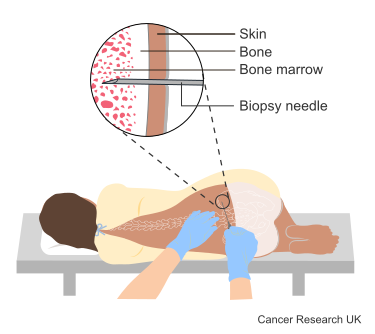
A doctor or specialist nurse removes a sample of bone marrow cells or an area of bone marrow in one piece. This is usually from your hip. A specialist doctor can then look at the cells or tissue under a microscope.
You usually have the test in the outpatient department of the hospital. But you may have this on the ward if you are staying overnight in hospital.
You're usually awake for the test. You have a to numb the area. Some people have medicine to make them drowsy. This is also known as sedation.
Bone marrow tests are usually done for cancers that are most likely to affect the bone marrow, such as:
lymphomas
leukaemias
myeloma
But it can be done for any type of cancer. This is usually if your doctor thinks your bone marrow could contain cancer cells, or they need to rule this out for any reason.
There are 2 main types of bone marrow test:
bone marrow aspiration
bone marrow trephine biopsy
Aspiration means the doctor or nurse draws some liquid bone marrow up into a syringe.
A bone marrow trephine biopsy means they remove a very thin 1 or 2cm long core of bone marrow in one piece.
You usually have both of these tests done at the same time. They give some of the same information to the doctor, but there are differences. The bone marrow trephine shows the structure of the bone marrow inside the bone, whereas the aspiration takes just the bone marrow cells.
Your nurse will explain any special preparation for the test. You might also have an information leaflet explaining what happens. Contact your healthcare team if you have any questions about the test and the preparation.
You are usually able to eat and drink before your test.
Tell your doctor or nurse before the biopsy if you take medicine to thin the blood. They will tell you if you need to stop taking these medicines and how long you should do this before your test.
Some people have this with . If you are having it this way, you should stop eating and drinking for a few hours before the test. Your nurse will give you more information about this.
Your doctor or nurse gives you information about the procedure and asks you to sign a consent form. This is a good time to ask any questions you have.
You might need to change into a hospital gown. You can usually keep your underwear on.
You lie on your side with your knees tucked up into your chest.
Your doctor or nurse cleans the area with some antiseptic fluid. This can feel cold.
You'll then have an injection of local anaesthetic into the skin over the biopsy site to numb the area. This might be uncomfortable, and it may sting, but this should only last a short time.
When the area is numb, your doctor or nurse puts a needle with a syringe into the hip bone and draws a small amount of liquid bone marrow. You might feel a pulling sensation when they start drawing the bone marrow cells out.
They take this needle out and put the second one in if you are having a trephine biopsy. The aim is to get a small amount of marrow out in one piece. You might also feel some pressure in the area where the sample is taken. Tell your nurse or doctor if this is uncomfortable. They will do all they can to make you more comfortable. When they have the sample, they remove the needle.
When the test has finished, a small sterile dressing is placed over the biopsy site.
The whole test takes around 30 minutes.
Take a look at this 2 minute video about having a bone marrow test.
Watch our British sign language version of this video on our Youtube channel
Some people prefer sedation before the test so that they are a bit drowsy. Some hospitals may use gas and air (Entonox) to help relax you instead of sedation.
If you are having sedation you will need to stay in the department for a few hours after your test to allow time to recover.
Children and teenagers often have sedation for this type of test.
We have a children's cancer section where you can find out about this test if your child has acute lymphoblastic leukaemia (ALL).
Find out how children have a bone marrow test
You usually go home the same day if you are feeling well enough.
You have a dressing over the site, which you should keep on for 24 hours. If you notice any bleeding apply pressure to the area. If it doesn't stop, contact your hospital 24 hour advice line.
After the test, your hip might ache for a couple of days. You may need some mild painkillers.
If you have sedation, you’ll need someone to take you home and stay with you overnight. Also, for 24 hours after, you shouldn’t drive, drink alcohol, or operate heavy machinery.
A bone marrow test is very safe and any risks are small. If you are worried call your hospital 24 hour advice line.
During the procedure there is a very small risk of damage to nearby structures, but this is very rare.
You might have a small amount of bleeding from the area where the needle went in. If you notice any heavy bleeding, apply pressure to the area. If it doesn't stop, contact your hospital 24 hour advice line.
Sometimes blood leaks out of the vein and collects under your skin. This can look like a small dark swelling under the skin.
There is a small risk of getting an infection in the wound. Contact your hospital advice line if:
you have a temperature or feel feverish
the area becomes red and sore
you have fluid oozing from the biopsy site
you feel generally unwell
Some people feel uncomfortable and have pain after the local anaesthetic has worn off. Your nurse will tell you what painkillers to take. If you have severe pain or it's getting worse then you should contact the hospital.
You may have some tingling in your leg which wears off with time.
Your bone marrow test is looked at in the laboratory. The time it takes to receive results depends on which tests are being done on the bone marrow samples.
Basic results can be available as soon as 24 to 48 hours. But it might take 1 to 2 weeks to get all your results. You won’t get any results at the time of having a bone marrow taken. It’s best to ask your doctor or nurse how long it will take to get them.
Waiting for test results can make you anxious. You might have the contact details of a specialist nurse who you can speak to for information and support if you need to. It may also help to talk to a close friend or relative about how you feel.
We have more information on tests, treatment and support if you have been diagnosed with cancer.
Last reviewed: 08 Apr 2025
Next review due: 08 Apr 2028
Find out about tests to diagnose cancer and monitor it during and after treatment, including what each test can show, how you have it and how to prepare.
Search for the cancer type you want to find out about. Each section has detailed information about symptoms, diagnosis, treatment, research and coping with cancer.
Cancer is the name given to a collection of related diseases. Cancer starts when cells change abnormally.

About Cancer generously supported by Dangoor Education since 2010. Learn more about Dangoor Education



Search our clinical trials database for all cancer trials and studies recruiting in the UK.

Connect with other people affected by cancer and share your experiences.

Questions about cancer? Call freephone 0808 800 40 40 from 9 to 5 - Monday to Friday. Alternatively, you can email us.
