Tests and scans
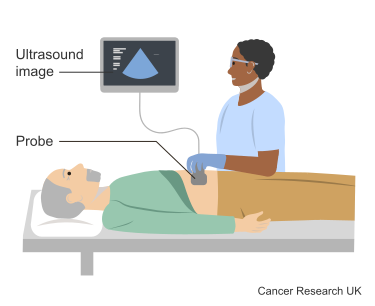
The ultrasound scanner has a probe that gives off sound waves. The probe looks a bit like a microphone. The sound waves bounce off the organs inside your body, and the probe picks them up. The probe links to a computer that turns the sound waves into a picture on the screen.
Ultrasound scans aren't painful but can cause some discomfort. You might have it at one of the following:
your GP surgery
local community clinic
in your hospital x-ray or ultrasound department
A specialist healthcare professional called a sonographer or a usually does the test.
Ultrasound scans can help to:
diagnose conditions including a number of different types of cancer
guide doctors when they need to take a tissue sample (biopsies)
There are different types of ultrasound scans. The type you need depends on the area of your body you're having scanned. They include:
external ultrasound scan - when the doctor or sonographer moves a probe over your skin
internal ultrasound scan - when the doctor or sonographer inserts a probe into your body. For example, into your vagina or back passage
Examples of external ultrasound include:
a breast ultrasound
a testicular ultrasound
an ultrasound of the head and neck area
an ultrasound of the tummy (abdomen)
You might have an ultrasound of your tummy to look at a particular organ or area. For example the:
liver, pancreas, gallbladder and bile ducts
urinary system including the bladder, kidneys, and
the female reproductive system including the ovaries, , fallopian tube and - called a pelvic ultrasound
Your GP or cancer specialist can explain which area the scan will look at and why you are having it.
You can find more information about some of these scans on the A to Z lists of tests
Check your appointment letter for any instructions about how to prepare for your scan.
You might need to stop eating for 6 hours beforehand. Let the scan team know if this will be a problem for any reason, for example if you are diabetic.
They might ask you to drink plenty before your scan so that you have a comfortably full bladder.
Take your medicines as normal unless your doctor tells you otherwise.
Before the test you might be asked to remove your clothing and put on a hospital gown. It will depend on what part of the body you're having scanned as to whether you have to undress or not.
You lie on the couch next to the ultrasound machine. You might be able to sit up depending on which part of your body is being scanned.
The sonographer will spread a clear gel onto your skin over the area they are checking. The gel feels cold. It helps to transmit the sound waves to the probe. The scan appears on a screen next to you.
You might feel a little pressure as the sonographer presses the probe against your skin and moves it around the area they are scanning. Tell them if this is uncomfortable.
If you are having an ultrasound of your tummy (abdomen) the sonographer might ask you to go to the toilet to empty your bladder during the test. They will do another scan straight after. The sonographer will let you know if you need to do this.
An ultrasound scan can take up to 45 minutes depending on what's being scanned.
You can usually eat and drink normally after the test. You can go straight home or back to work afterwards.
Sometimes, doctors need to put the ultrasound probe inside your body to get a clearer picture. Examples of an internal scan include:
a rectal ultrasound to look at the prostate gland
a vaginal ultrasound to look at the ovaries, womb and surrounding structures
an endoscopic ultrasound to look at your
an endobronchial ultrasound (EBUS)- to look at the inside of the breathing tubes (airways) in your lungs
You have this scan to check your prostate gland. This is called a transrectal ultrasound or TRUS. Trans rectal means that the doctor examines your prostate by putting the ultrasound probe into your back passage (rectum). The probe is about the width of a thumb. It's covered with a protective sheath like a condom and has some lubricating gel on it.
You might also have a TRUS guided . For this test your doctor takes a sample of tissue during a TRUS. They use a thin needle to take the biopsy from the prostate.
Read about having a transrectal ultrasound (TRUS) and biopsy
During a transvaginal ultrasound scan the probe is put into the . The scan can show changes in your womb, ovaries, and other areas of the pelvis. For example, thickening of the womb lining.
A transvaginal ultrasound scan shouldn't be painful but can cause some discomfort.
Read more about having a transvaginal scan
This is a combination of having an endoscopy and an ultrasound. An endoscope is a long flexible tube with a light and camera attached.
Doctors usually use it to look at the inside of your digestive system. The endoscope can also have an ultrasound probe at the tip. This gives doctors more detailed information.
Doctors use endoscopic ultrasound to look at:
the wall of the oesophagus (food pipe)
the wall of the stomach
part of the small bowel (duodenum)
the gallbladder and bile ducts
Get more information on having an endoscopy
This test uses a narrow flexible tube to look at the inside of the breathing tubes (airways) in your lungs. The tube has an ultrasound probe. It uses high frequency sound waves to create pictures of the lungs and structures outside the airway walls, such as the .
Your doctor can see any areas that look abnormal and take samples (biopsies) to test.
Find out more about having an endobronchial ultrasound
Your scan will be looked at by a specialist doctor and you should get your results within 1 or 2 weeks. You won't get any results at the time of the scan.
Waiting for test results can make you anxious. Ask your doctor or nurse how long it will take to get them. Contact them if you haven’t heard anything after a couple of weeks.
You might have the contact details for a specialist nurse. You can contact them for information and support if you need to. It may help to talk to a close friend or relative about how you feel.
Contact the doctor that arranged the test if you haven't heard anything after a couple of weeks.
We have more information on tests, treatment and support if you have been diagnosed with cancer.
Last reviewed: 16 Sept 2025
Next review due: 16 Sept 2028
Search for the cancer type you want to find out about. Each section has detailed information about symptoms, diagnosis, treatment, research and coping with cancer.
Find out about tests to diagnose cancer and monitor it during and after treatment, including what each test can show, how you have it and how to prepare.

About Cancer generously supported by Dangoor Education since 2010. Learn more about Dangoor Education



Search our clinical trials database for all cancer trials and studies recruiting in the UK.

Connect with other people affected by cancer and share your experiences.

Questions about cancer? Call freephone 0808 800 40 40 from 9 to 5 - Monday to Friday. Alternatively, you can email us.
