Treatment
The main treatments for breast cancer include:
surgery
chemotherapy
radiotherapy
hormonal therapy (also called endocrine therapy)
targeted cancer drugs and immunotherapy
bone strengthening drugs (bisphosphonates)
You usually have a combination of these treatments, depending on your situation. This is why your treatment may be different from other people with breast cancer.
This page is about treatment options for breast cancer that hasn’t spread to other distant parts of the body. We also have information about treatment options for breast cancer that has spread to other distant parts of the body such as the lungs, liver or bones. This is secondary or advanced breast cancer.
Go to our information about secondary breast cancer
A team of doctors and other professionals discuss the best treatment and care for you. They are called a multidisciplinary team (MDT). The team includes a:
breast surgeon
medical cancer specialist or oncologist
breast cancer nurse or clinical nurse specialist (CNS)
breast cancer research nurse
doctor who specialises in looking at scans (radiologist)
doctor who specialises in looking at cells under a microscope (pathologist)
doctor who can create a new breast after having it removed (plastic surgeon specialising in breast reconstructions)
Your team reviews the scans and tests, and recommends the best treatment for you. They will explain its benefits and possible side effects.
Your treatment depends on:
where your cancer is
how big the cancer is and whether it has spread (the stage)
the type of cancer
how abnormal the cells and tissues look under a microscope (the grade)
whether you have had the
whether the cancer cells have certain proteins called
your general health and level of fitness
your personal choice
Your doctor might offer you a choice of treatments. Discuss each treatment with them, and ask about the benefits of the treatment and the side effects. This helps you make the right decision. You also need to think about other factors for each treatment such as:
whether you need extra appointments
if you need more tests
You might have to make further choices as your situation changes. It helps to find out as much as possible each time.
Most people begin their breast cancer treatment with surgery. Some people may have chemotherapy or hormonal therapy before surgery.
There are different types of surgery.
Depending on the size and position of the cancer, you might be able to have just the cancer and a border of normal breast tissue removed. This is also called a lumpectomy or wide local excision.
Find out more about breast conserving surgery
Your surgeon may recommend you have the whole breast removed. This is a mastectomy. You can have a new breast shape made (a breast reconstruction) at the time of surgery, or sometime later.
Find out more about having a mastectomy and breast reconstruction
Cancer cells can break away from the breast tissue and go to other parts of the body. If this happens, it usually first spreads to the in the armpit (axilla) close to the breast.
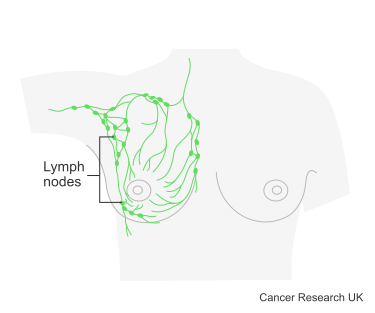
You usually have an ultrasound scan to look at the lymph nodes in the armpit. If your doctor sees any changes in the lymph nodes, they might take a .
If the lymph nodes look normal on the ultrasound, you usually have a sentinel lymph node biopsy during your breast surgery. This is to make sure that cancer has not spread to the sentinel lymph node. The sentinel node is the first node fluid drains from the breast into the armpit.
Your doctor usually suggests surgery to remove all or some of the lymph nodes in your armpit if the results show that you have cancer cells in the lymph nodes. This is called an axillary lymph node clearance or a targeted axillary dissection. You have the operation on your armpit at the same time as your breast cancer surgery or as a second operation.
Find out more about surgery to remove lymph nodes
Radiotherapy uses high energy x-rays to kill cancer cells. You usually have radiotherapy after breast conserving surgery. This is usually between 5 to 15 radiotherapy treatments ().
Some people may also have radiotherapy after a mastectomy. For example, if the cancer has spread to the lymph nodes or is bigger than 5cm.
Depending on your situation, you may also have radiotherapy to the lymph nodes in your armpit.
Find out about radiotherapy for breast cancer
Chemotherapy uses anti cancer (cytotoxic) drugs to destroy cancer cells. The drugs circulate throughout the body in the bloodstream. You might have chemotherapy before surgery, after surgery or both.
Chemotherapy before surgery is called neo adjuvant treatment. The aim is to shrink the cancer before the operation and reduce the risk of the cancer coming back in the future. This means that some people may be able to have breast conserving surgery, instead of a mastectomy.
Chemotherapy after surgery is called adjuvant treatment. This can help to reduce the risk of the cancer coming back.
Read more about chemotherapy for breast cancer
Some breast cancers need the hormone to grow. Hormone therapy works by lowering the levels of this hormone in the body, or blocking their effects.
Hormone therapy is only likely to work if the breast cancer cells have proteins (receptors) for oestrogen. They are called oestrogen receptor positive breast cancer.
The most common way to have hormone therapy is after surgery for breast cancer. You usually have it for 5 years or more. But exactly how long you have it depends on the type of drug and the side effects you may have.
You may also have hormone therapy before surgery. This is to try to shrink the cancer before the operation. This is called neo adjuvant hormone therapy.
Find out more about hormone therapy for breast cancer
Targeted cancer drugs work by targeting the differences in cancer cells that help them to grow and survive. Immunotherapy works by helping our recognise and attack cancer cells.
There are a number of targeted cancer drugs but not all will be suitable for you. Some targeted drugs are only available if the breast cancer cells have certain receptors. For example, some breast cancers have large amounts of a protein called Human Epidermal Growth Factor 2 (HER2). These are HER2 positive breast cancers. So in this situation, you may have treatment that target the HER2 receptors.
Your doctor may also suggest you have treatment with a type of targeted drug called a CDK4/6 inhibitor. These drugs work by blocking certain proteins that stimulate cancer cells to divide and grow. An example of this is a drug called abemaciclib. You may have abemaciclib if you have hormone receptor positive and HER2 negative breast cancer.
Your doctor might suggest you have treatment with an immunotherapy drug called pembrolizumab. You may have pembrolizumab if you have triple negative breast cancer. This means that the cancer cells do not have receptors for:
the hormones oestrogen and progesterone
HER2
Find out more about targeted cancer drugs and immunotherapy for breast cancer
Bisphosphonates are drugs that help prevent or slow down bone thinning (osteoporosis). They can help to strengthen bones and reduce the risk of bones breaking.
You might have bisphosphonates to help prevent or slow down bone thinning. You may also have it to reduce the risk of breast cancer spreading to the bones if you have had the menopause. You usually have a drug called zoledronic acid or sodium clodronate.
Read more about having treatment with bisphosphonates
It can be difficult to choose the best treatment for you. Your doctor and specialist nurse will explain the different treatment options and help you make a decision. A specialised computer programme called Predict can also help you and your doctor decide which treatment might be best in you.
Doctors can type the details of your cancer into the computer database and then add in different types of treatment. The programme then tells how much each treatment reduces the chance of the cancer coming back.
Speak to your doctor if you want to find out more about this or if you need help using the tool.
Your doctor may suggest you have tumour profiling tests. These are also called gene expression profiling tests (GEP tests). The results give your doctor information about whether or not chemotherapy can lower the risk of your cancer coming back.
There are different types of tumour profiling tests for breast cancer. They include:
EndoPredict (EPclin score)
Oncotype DX Breast Recurrence Score
Prosigna
Doctors usually do this test by using a sample of the cancer taken during surgery. This means that you will not need any extra tests. Your doctor can tell you whether tumour profiling tests are an option for you.
Treatment decisions can be complicated and confusing. You can ask for a second opinion if you would like to get another doctor's view on your treatment. This means going to see another specialist. They will need to see all your test results.
Having a second opinion doesn't usually mean that the new doctor takes over your treatment and care. They discuss with you and your current doctor which is the best treatment approach to take.
It can take time to arrange a second opinion and it might mean that your treatment is delayed for a while.
It is worth discussing your treatment again with your current doctor first. Once you have heard why they are suggesting particular treatments, you might feel that you don't need a second opinion.
Write down all your questions before the appointment with your specialist. It can be difficult to remember everything you want to ask once you get there. Writing down your questions beforehand can help you to feel more confident during the discussion.
Read more about getting a second opinion
Doctors are always trying to improve treatments and reduce side effects. Your doctor might ask you to participate in a clinical trial as part of your treatment. This might be to investigate a new test, a new cancer treatment or to look at different combinations of existing treatments.
Your doctor will tell you if there are any trials that you can enter.
Read about research and clinical trials
JoC was diagnosed with lobular cancer in 2021.
"I've had the cancer removed and a reconstruction of the breast. I'm awaiting radiotherapy and hormone suppression treatment."
Read JoC's story about her cancer diagnosis, treatment and how she coped
Last reviewed: 30 Jun 2023
Next review due: 30 Jun 2026
Get information about how doctors stage and grade breast cancer. In the UK, doctors use the TNM system to stage breast cancer. You may also be told about the number staging system.
These can help to find out the type of breast cancer you have and look for proteins (receptors) on the surface of breast cancer cells. They can also look at cancer genes (tumour profiling tests).
Secondary breast cancer means that a cancer that began in the breast has spread to another part of the body such as the bones or lungs.
There are different types of breast cancer and breast conditions, including breast cancer in men, and conditions related to breast cancer. Find out more about the different types.
Get practical, physical and emotional support to help you cope with a diagnosis of breast cancer, and life during and after treatment.
Find out about breast cancer, including symptoms, diagnosis, treatment, survival, and how to cope with the effects on your life and relationships.

About Cancer generously supported by Dangoor Education since 2010. Learn more about Dangoor Education



Search our clinical trials database for all cancer trials and studies recruiting in the UK.

Connect with other people affected by cancer and share your experiences.

Questions about cancer? Call freephone 0808 800 40 40 from 9 to 5 - Monday to Friday. Alternatively, you can email us.
