Treatment
You will meet the surgical team and have the chance to go over worries or questions before surgery. If your child is able to, you might want to encourage them to ask questions too. Sometimes what they’re imagining is different and scarier than what actually happens.
The Brain Tumour charity has made an animation for children following Jake, who is having neurosurgery.
Your child might have surgery to find out what type of brain tumour they have. Your child’s surgeon removes a small amount of tumour (a biopsy). They send this to the laboratory. Looking at the tumour under a microscope is the only way to be sure of the diagnosis.
Read more about a biopsy test for children’s brain tumours
Other reasons they might have surgery are to:
try and remove the whole tumour
remove as much of the tumour as possible to slow its growth and improve symptoms
relieve symptoms, such as a build-up of fluid in the brain
help give other treatments such as chemotherapy, but this is rare in children
Removing some of the tumour can also help other treatments, such as radiotherapy or chemotherapy to work better.
Surgery isn’t suitable for every child with a brain tumour.
Sometimes the tumour is in a very delicate area of the brain. Having surgery to remove the tumour would cause more harm than good. This might be the case if the tumour is in the brainstem.
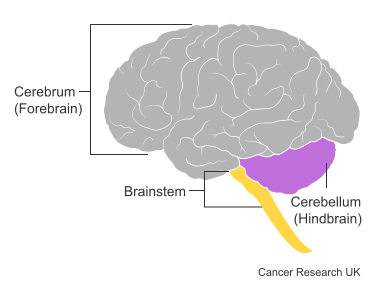
The brainstem controls body functions we don’t think about including:
breathing
blood pressure
heart rate
swallowing
coughing and sneezing
Your child’s team will talk with you about different treatment options if surgery isn’t suitable for them.
Slow growing tumours
Some children with slow growing (low grade) tumours don’t need surgery straight away. Your child will have regular scans and assessment of their symptoms to look for any further tumour growth.
Neurosurgeons operate on brain tumours. Paediatric neurosurgeons are brain surgeons for children. These are highly skilled and specialised doctors.
Your child’s operation might involve a team of neurosurgeons. Their consultant neurosurgeon leads the team on the day of surgery.
You might have other specialists working with the team. For example, there might be an Ear, Nose and Throat (ENT) surgeon if your child has a pituitary tumour.
Your child will usually go into hospital at least the night before their operation. This is so their team can check if they are okay to have surgery. This is known as being fit for surgery.
To check this, your child has some tests. Your child might have had some of these tests already, and not every child has all of them. They include:
blood tests – including one to check their blood type and assess how well their blood is clotting
an ECG to check that their heart is healthy
an echocardiogram (ECHO) - a painless test to check the structure and nearby blood vessels of their heart and how well it’s pumping. It uses sound waves to create this information
a chest x-ray to check that their lungs are healthy
tests such as swabs to check for infection
Nearly all children having brain surgery have a general anaesthetic. This means they are asleep and can’t feel any pain during the operation. It’s important that your child doesn’t eat anything, or have any milk, for 6 hours before a general anaesthetic. They can drink water or clear fluids until a few hours before the operation. Their team will tell you exactly when.
The anaesthetist gives your child the anaesthetic. They look after them and their breathing throughout the operation. You and your child will meet the anaesthetist before the operation.
Your child’s surgeon will ask you to sign a consent form before the operation. This is a good time to ask any questions you have about during, or after, the operation. They can give you written information so that you can look back over it to make sure you understand and remember everything.
This can be a very difficult time. It might be good to have a friend or family member with you when you get this information.
Older teenagers can sign their own consent forms if they are able to understand all the information and what it means.
The skin is the largest organ of the body. It has several roles and one of these is to protect the inside of the body from harmful things such as germs. The skin is not sterile. So before surgery your child usually has a shower or bath to help lower the risk of getting an infection. Some places may give you an antiseptic soap to wash with. Others may ask you to use your own soap.
Most children have a small area of their hair shaved. This is so your child’s surgeon can have clear access to the part of the brain they need to operate on. Some children have all their head shaved.
It depends on where the tumour is and the type of operation they have. Your child’s surgeon will explain what to expect.
The operating nurse usually removes the hair when your child is under anaesthetic in the operating room.
Do not shave your child’s head before you come to hospital for the operation. This could increase the risk of a wound infection.
Your child won't need to have their head shaved if they’re going to have an operation to remove a pituitary tumour. The surgeon removes this type of tumour through the nose.
For tumours in the brainstem or back part of the brain (cerebellum), your child’s surgeon might only need to shave a small area at the back of their head.
There are different types and ways of doing brain surgery. What exactly happens in the operation depends on where the tumour is and the safest way to try and remove it. Your child’s surgeon might use different scans and instruments to make sure the operation is as successful as possible.
Ask your child’s surgeon exactly what the operation involves. They will go into as much or as little detail as you want. It’s important that you and your child voice any concerns you have before the operation.
Your child’s nurse or doctor puts a small tube (cannula) into your child’s hand or arm. The nurse puts some local anaesthetic cream on the area first, to numb the area. Your child might still feel the needle go in, but it shouldn’t be painful.
You can usually go with your child to theatre before the operation. You wait with your child in a room next to the theatre, called the anaesthetic room. You can give your child a cuddle and reassure them until they are beginning to fall asleep, ready for the operation. A play specialist can also go to the anaesthetic room with you. They can help prepare your child and make everything less frightening.
The anaesthetist gives your child their anaesthetic through the cannula in their hand. Or they gently place a mask over your child’s mouth and your child breathes the anaesthetic gas until they fall asleep. The team then take over, and the nurse will take you back to the ward. A member of the team lets you know when the operation has finished.
It’s not unusual for you to feel very emotional. The theatre or ward team will take your mobile number to call you as soon as the surgery is over. As a guide, neurosurgery can take up to 6 hours. And sometimes much longer. Children can also take time to wake up from their anaesthetic. This is all normal.
Try and get some rest, take a shower or eat something during this time. It’s good to try and get some fresh air if you can.
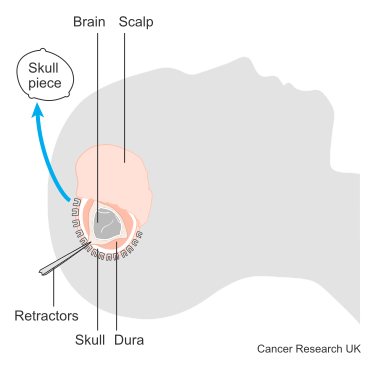
A craniotomy is the most common type of operation to remove a brain tumour.
Your child’s surgeon first cuts into the skin covering the head (scalp). The surgeon then cuts out an area of bone from the skull. This gives an opening so that the surgeon can operate on the brain itself. The piece of bone that’s removed is called a bone flap.
The scans your child had before their operation help the surgeon know where exactly the tumour is. These are usually specialised MRI scans.
Read about MRI scans for children
Scans are also sometimes carried out during surgery. Some surgeons use an image guided system, where the scans are loaded into a computer to give the precise position of the tumour.
The scans they might use during an operation include ultrasound, MRI or CT scans.
During surgery, your child also has monitoring in place to check certain functions of the brain during surgery. This is to check your child’s motor, sensory, visual or language functions. Your child’s surgeon works to safely remove all or as much of the brain tumour as possible.
Afterwards, the surgeon puts the bone flap back. They secure the flap with permanent tiny metal plates and screws, or they might stitch it in place. Then they stitch the scalp in place over it. In most cases, your child’s hair will hide the operation scars.
In a small number of cases, the flap can’t be put back straight away due to swelling in the area. The surgeon closes the scalp with stitches. Your child will need another operation to close the hole in the skull.
Very rarely older teenagers have an awake craniotomy. This might be because they have a tumour near part of the brain that involves speech, movement or hearing.
During an awake craniotomy, the surgeon asks your child to do tasks while checking the function of different parts of the brain. For example, they might ask them to speak. Or move part of their body, or check what they can feel. This is called function mapping. The surgeon can make sure that these functions are harmed as little as possible, if at all.
These older teenagers are well prepared by specialist members of the multi disciplinary team (MDT) for an awake craniotomy. They don’t feel any pain.
The cerebrospinal fluid (CSF) is the fluid that surrounds the brain and spinal cord. Some brain tumours block the normal circulation of this fluid. Because it can’t drain away, the fluid builds up in the skull and around the spinal cord (hydrocephalus).
This increases the pressure inside the head (intracranial pressure). It can cause symptoms, such as headaches and sickness.
Your child might have surgery to drain a build up of fluid in the brain. The surgeon puts in a device called a shunt. This might be at the same time as their operation to remove the tumour, or as a separate operation. They have this under general anaesthetic.
Some children have an external ventricular drain (EVD) in place after surgery to help remove extra CSF.
A shunt is a drainage tube. Shunts are usually plastic and small, about 0.3cm (3mm) across. Another name for them is ventricular catheters.
They have valves so that fluid can flow down from the brain but not back the other way.
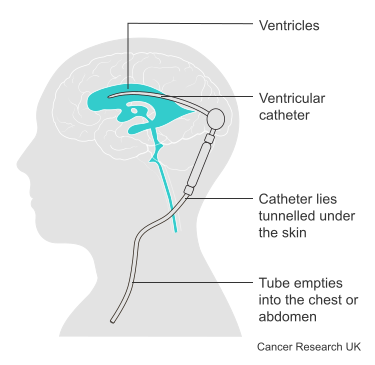
Shunts drain away the extra fluid from the ventricles of the brain to other parts of the body, where it’s absorbed.
The most common type is the ventriculoperitoneal shunt. This is a tube from the brain ventricles into the abdomen (tummy). Another type drains the fluid into the chest cavity.
You can’t see it’s there from outside the body. Some children have a shunt for a short time and then it’s removed. Other children have them for much longer, as part of their treatment plan.
This is a temporary drain that allows extra cerebrospinal fluid from the ventricles to drain into a container. The container is attached to a soft flexible tube that is held in place in the ventricles of the brain with stitches.
This drain is kept at a certain height so there is a steady flow. The fluid that is collected is measured, checked and recorded carefully.
Your child is closely monitored while they have this drain in place.
During brain surgery, your child's surgeon might put in a ventricular access device (an Ommaya reservoir). This device allows chemotherapy to be put straight into the fluid filled spaces of the brain (ventricles).
We have information about these in the chemotherapy section.
Find out more about chemotherapy for children’s brain tumours
We have information on what happens straight after surgery and longer term recovery from brain surgery. You can read about the possible side effects of surgery and shunts.
Find out more about what happens after surgery
This page is due for review. We will update this as soon as possible.
Last reviewed: 14 Dec 2022
Next review due: 14 Dec 2025
The main treatments for children’s brain and spinal cord tumours are surgery, radiotherapy and chemotherapy.
Chemotherapy uses anti cancer (cytotoxic) drugs to destroy cancer cells. Chemotherapy can work well for some types of brain tumour. Find out when they might have it, the drugs used, how they have it and the side effects.
Radiotherapy is a common treatment for children’s brain tumours. Find out what type of radiotherapy they might have, what happens before, during and after radiotherapy.
Brain tumours and their treatment can cause physical and mental changes. Understanding about what they might be can help you cope.
It is essential that parents and other close family have support. Find out what is availble and who can help.
Brain tumours are the second most common type of children’s cancer in the UK. Around 420 children are diagnosed with these tumours each year in the UK.

About Cancer generously supported by Dangoor Education since 2010. Learn more about Dangoor Education



Search our clinical trials database for all cancer trials and studies recruiting in the UK.

Connect with other people affected by cancer and share your experiences.

Questions about cancer? Call freephone 0808 800 40 40 from 9 to 5 - Monday to Friday. Alternatively, you can email us.
