Metastatic prostate cancer
Metastatic prostate cancer commonly spreads to in other parts of the body or to the bones. It can also spread to other organs such as the lungs.
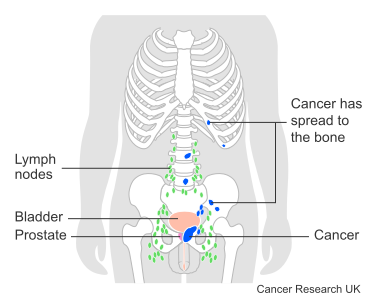
Locally advanced prostate cancer is different to advanced prostate cancer.
Locally advanced cancer means that the cancer has spread into nearby tissue and lymph nodes around the prostate. It may have spread into the:
tissue around the prostate
the tubes that carry semen - these are the seminal vesicles
body organs nearby such as the back passage or bladder
lymph nodes close to the prostate gland
Find out more about locally advanced prostate cancer
Prostate cancer can spread anywhere but most commonly spreads to the:
bones
lymph nodes
liver
lungs
Your doctor will arrange some scans and tests if you have symptoms that could be due to metastatic prostate cancer. They will also examine you and find out how you are feeling.
Find out about the symptoms of metastatic prostate cancer
TNM stands for Tumour (T), Node (N) and Metastasis (M). The staging is different depending on the type of cancer you have.
The information below is an overview of the TNM staging for all types of cancer.
T describes the size of the tumour (cancer)
N describes whether there are any cancer cells in the nearby lymph nodes
M describes whether the cancer has spread to parts of the body further away from where the cancer started
The doctor gives each factor (T, N and M) a number. The number depends on how far the cancer has grown or spread.
So, a very small cancer which hasn't spread to the lymph nodes or elsewhere in the body may be T1 N0 M0.
A larger cancer that has spread into the nearby lymph nodes and to another part of the body may be T3 N1 M1.
In the TNM staging system, metastatic prostate cancer is any T, any N, M1.
Find out more about the TNM staging system for prostate cancer
You might have tests to help diagnose metastatic prostate cancer. These can be similar to tests to diagnose prostate cancer, so you might have had some of them before.
Find out more about tests to check for prostate cancer
Your treatment depends on:
your age and general health
how you feel about the treatments and side effects
There are different treatments for metastatic prostate cancer. These include:
hormone therapy
chemotherapy
steroids
radiotherapy
targeted drugs
radioisotope therapy
symptom control such as treatment to help with bone pain
Find out more about treatment options for metastatic prostate cancer
Unfortunately, when prostate cancer has spread to other parts of the body, it can no longer be cured. But treatment can control it for some time and help to relieve symptoms.
Finding out that your cancer can’t be cured is distressing and can be a shock. It’s common to feel uncertain and anxious. It's normal not to be able to think about anything else.
Lots of information and support are available to you, your family and your friends. It can help to find out more about your cancer and the treatments you might have. Many people find that knowing more about their situation can help them cope.
Talk to your doctor or nurse to understand:
what your diagnosis means
what is likely to happen
what treatment is available
how treatment can help you
You and your family will be looked after by a team of healthcare professionals who can support you.
Find out more about coping with metastatic prostate cancer
Many people want to know what the outlook is and how their cancer will develop. This is different for each person. Your cancer specialist has all the information about you and your cancer. They're the best person to discuss this with.
You can also talk to your specialist nurse.
For information and support, you can phone the Cancer Research UK nurses on 0808 800 4040, from Monday to Friday, 9am to 5pm.
Last reviewed: 21 Jul 2025
Next review due: 21 Jul 2028
The symptoms of metastatic or advanced prostate cancer depend on where the cancer has spread to. They might include bone pain and tiredness.
Metastatic prostate cancer has spread to other parts of your body. Treatment options include chemotherapy and hormone therapy.
You have a number of tests to check for prostate cancer. These may include a digital rectal examination, a PSA blood test, scans and a biopsy.
Doctors use Grade Groups and other information to divide prostate cancer into 5 groups called the the Cambridge Prognostic Group (CPG). The stage tells you the size of the cancer and whether it has spread.
Get practical and emotional support to help you cope with a diagnosis of prostate cancer, and life during and after treatment.
Prostate cancer is cancer that starts in the prostate gland. The prostate gland is found at the base of the bladder and is about the size of a walnut.

About Cancer generously supported by Dangoor Education since 2010. Learn more about Dangoor Education



Search our clinical trials database for all cancer trials and studies recruiting in the UK.

Connect with other people affected by cancer and share your experiences.

Questions about cancer? Call freephone 0808 800 40 40 from 9 to 5 - Monday to Friday. Alternatively, you can email us.
