Stem cell and bone marrow transplants
This page is about an allogeneic transplant. This is also called an allograft.
This is different to an autologous transplant, which uses your own stem cells, instead od stem cells from a donor.
Read about a transplant using your own stem cells
Doctors usually collect stem cells from the donor's bloodstream, but sometimes they take them from the donor's bone marrow. Some people might have stem cells from donated umbilical cord blood. Cord blood is used less often that other types of transplant.
Your medical team look at a number of factors to decide whether you have a donor transplant. These include:
your type of cancer
what other treatments you have had
your general health
whether your medical team can find a suitable donor or match
There are different steps or stages of an allogeneic transplant:
preparation
finding a donor
conditioning treatment
stem cell collection from your donor
you have your donor's
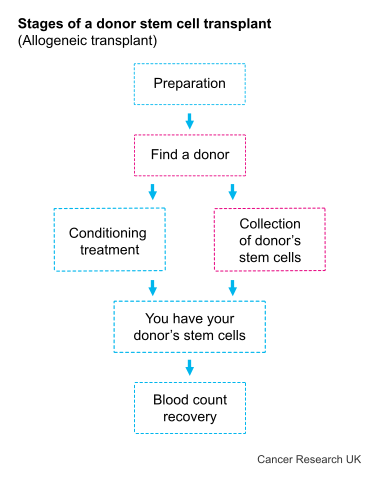
To prepare for your transplant, you have:
various tests
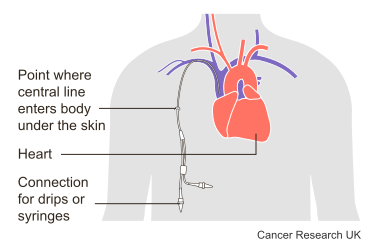
a central line put in
The central line can stay in your vein for many months. So you don't need to have needles in your hand or arm each time you have treatment. You can also have anti sickness medicines and antibiotics through your central line. And your nurses can take blood samples from your line.
As part of your preparation, you might have chemotherapy to get rid of as many cancer cells as possible.
Your treatment could mean it is difficult to become pregnant or father a child in the future. Talk to your healthcare team if this is a concern for you. You might be able to store sperm or eggs before starting treatment.
Treatment can cause an early menopause in some women. Sometimes it is possible for women to freeze their eggs or embryos before cancer treatment. But it takes time to stimulate your ovaries to collect the eggs. Your doctor may not want you to delay starting cancer treatment.
Men may be able to bank sperm before starting any treatment.
Ask your doctor and nurse if you're not sure about anything. They can explain what your options are.
Read more about stem cells and how a transplant works
Ideally, your donated stem cells need to match your own. A brother or sister is most likely to be a close match.
Sometimes, if you don't have a brother or sister who is a match, you can have stem cells from a donor. This could be a donor who is not related to you but whose stem cells are similar to yours. This is called a matched unrelated donor (MUD) transplant.
Some people might have stem cells that are not a perfect match (but partly match). This is called a mismatched transplant.
Some people might have stem cells from donated umbilical cord blood. But this is not as commonly used.
Read more about stem cells and how a transplant works
Once a donor is found, you have conditioning treatment. There are different drugs and regimes. What you have depends on your individual circumstances. There are also different strengths of conditioning treatment. The 2 main types are:
full intensity (myeloablative) conditioning
reduced intensity conditioning (RIC)
Your doctor might also call this myeloablative conditioning or MAC. You have very high doses of chemotherapy. This is the more traditional transplant. When stem cell transplants were first developed, this was the type of conditioning that everyone had. With MAC, all of the cancer cells and healthy cells are destroyed. Your doctor might recommend you have MAC if you are young and you have certain types of cancer. For example, if you have acute leukaemia.
As well as chemotherapy, you might also have:
targeted drugs
radiotherapy to the whole body (total body irradiation or TBI)
You usually have TBI at the beginning or at the end of your chemotherapy.
With RIC you have lower doses of chemotherapy. Some healthy cells and cancer cells are left behind after treatment has finished. You might have RIC if you are not fit or well enough for full intensity conditioning. This is now the standard conditioning treatment for most types of cancer. You might also have targeted drugs with your chemotherapy.
RIC can have fewer side effects. But there is a greater risk of the cancer coming back, compared to MAC. Even though the doses of chemotherapy are lower, this can still be a difficult treatment to cope with. Your healthcare team monitor you closely through your treatment and when you go home.
Conditioning treatment can take about 7 days. But it could be shorter or longer depending on the drugs you have.
Look for more information about your drug treatment
Find out more about total body irradiation
Donors usually have stem cells collected from their bloodstream. When this happens, your donor has growth factor injections once a day for 4 days. The growth factor makes the stem cells spill out into their bloodstream. When there are enough stem cells, these are collected through a drip from their bloodstream.
Some donors have stem cells taken from their bone marrow. Your donor has a general anaesthetic for this. A doctor then puts a needle into their hip bone to remove the bone marrow.
The Anthony Nolan charity has more information for donors and what is involved.
After you have your chemotherapy and other treatments you have your donor’s stem cells. You have these through your central line into your bloodstream.
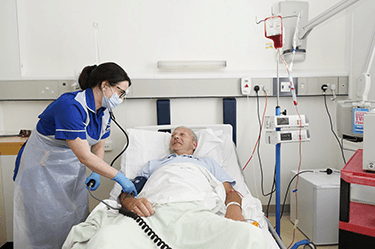
After conditioning treatment, you have low numbers of blood cells for some time. This means you are at risk of getting infections. You usually stay in hospital until:
your blood cells have recovered enough to go home
you no longer have any severe side effects
This might take 4 or 5 weeks following a donor transplant, although this time can vary from one person to another.
You might have a single room in the hospital ward to help protect you from infection. Your medical team might call this being in isolation.
While you are in isolation you can have visitors, but your nurses may suggest that you only have one or two each day. Your friends and relatives should not come to see you if they are not well. Or if they have been in contact with anyone with an infectious disease.
You might need to follow a special diet including foods that are unlikely to give you an infection.
Staying in a single room in hospital can feel lonely. Some people find it frightening. It can help to talk to the nurses about your worries. They can reassure you.
Taking in some of your personal things can make the room feel more homely. Books and photos can brighten it up. You can also take in a laptop, tablet, mobile and music. This can help the time to pass and you can keep in touch with friends and family.
Your donor stem cells find their way into your bone marrow where they make the blood cells you need. You have regular blood tests to check when your bone marrow starts to make new blood cells. This recovery of blood cells is called engraftment.
During this time, you continue to have treatment for any side effects and symptoms. This might include:
antibiotics and antiviral medicines to treat and prevent infection
platelet transfusions if the number of platelets in your blood is low
blood transfusions if your red blood cells are low
medicines to relieve a sore mouth, diarrhoea and sickness
Your doctor measures the proportion of cells that are from your donor. After RIC, it is normal at first to have some of your donor stem cells and some of your own cells. This is called mixed chimerism. Eventually, all your blood and bone marrow should ideally be from your donor. This is called full chimerism.
You have tests to check for chimerism every few months for about a year after your transplant.
Lymphocytes are a type of white blood cell. They are part of the immune system.
You might have some of your donor’s lymphocytes as a drip into your bloodstream. Increasing the amount of donor cells helps the immune system get rid of any of your remaining cells. So eventually you have full donor chimerism. You are more likely to need donor lymphocyte infusions if you have a transplant following RIC. Some people might need quite a few of these infusions. Other people may not need any.
You usually have donor lymphocyte infusions after you go home and as an outpatient.
Side effects of a donor transplant include:
increased risk of getting an infection
tiredness and lacking energy
increased risk of bleeding
sickness and diarrhoea
Read about the side effects of a stem cell or bone marrow transplant
This page is due for review. We will update this as soon as possible.
Last reviewed: 29 Nov 2022
Next review due: 29 Nov 2025
The side effects of a stem cell or bone marrow transplant include infection, bleeding, sickness and diarrhoea.
Search for the cancer type you want to find out about. Each section has detailed information about symptoms, diagnosis, treatment, research and coping with cancer.
Stem cell or bone marrow transplants are treatments for some types of cancer including leukaemia, lymphoma and myeloma. You have them with high dose chemotherapy and sometimes radiotherapy.

About Cancer generously supported by Dangoor Education since 2010. Learn more about Dangoor Education



Search our clinical trials database for all cancer trials and studies recruiting in the UK.

Connect with other people affected by cancer and share your experiences.

Questions about cancer? Call freephone 0808 800 40 40 from 9 to 5 - Monday to Friday. Alternatively, you can email us.
